
MUMBAI: RBI has proposed a set of safeguards to prevent digital payment frauds, including a mechanism that requires banks to seek approval from a trusted person assigned by the customer for large fund transfers and an account-wide ‘stop’ switch to block outgoing transactions immediately if they suspect their account has been compromised.The proposals are part of the draft Reserve Bank of India (Commercial Banks – Responsible Business Conduct) Fifth Amendment Directions, 2026. The framework also requires banks to give customers greater control over digital payment channels and transaction limits while expanding the circumstances in which banks can be held liable for fraudulent transactions.
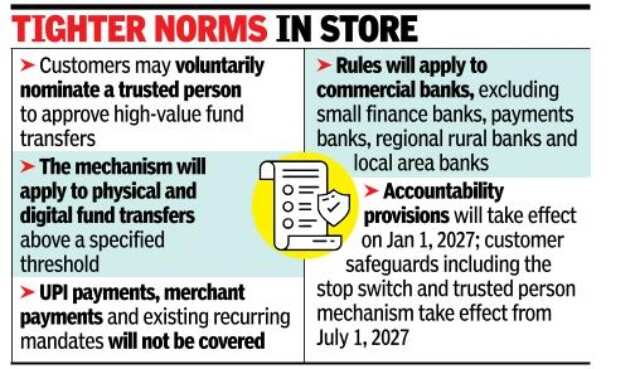
Under the proposed Trusted Person Mechanism, account holders can voluntarily designate a person to provide an additional layer of authentication for transactions. Once activated, any fund transfer will trigger an alert to the trusted person who will have one hour to approve or reject the transfer.Unapproved transactions will be automatically cancelled. The mechanism will cover physical and digital fund transfers above the specified threshold but exclude UPI payments, merchant payments and existing recurring mandates. Approving or rejecting a transaction will not make the trusted person financially liable.Secondly, customers can use an account-wide stop switch, available through branches, ATMs, net banking, mobile apps and IVR, to block outgoing payments, new mandates and UPI registration on third-party apps. Incoming credits, existing recurring mandates and bank-initiated recoveries will continue. Deactivation will require stringent authentication and a risk-based cooling period. An earlier proposal of one-hour latency for transfers has been dropped.Customers can switch digital channels on or off, set disabling time windows and transaction limits by channel, beneficiary or day. Debit, credit and prepaid cards will have similar controls for domestic/international, ATM, PoS, online and contactless transactions, excluding gift and transit PPIs. Digital channels will be disabled by default for new accounts, with a bank-set limit for the first 24 hours after activation. New cards will initially allow only domestic contact-based ATM and PoS transactions.RBI has expanded bank negligence to cover failures in multi-factor authentication, customer-set controls, fraud alerts, 24×7 reporting and prompt action on complaints, as well as failure to block channels after repeated failed logins. System malfunctions, bank-side security breaches and collusion by employees or vendors will also attract liability. The rules will apply to commercial banks, excluding small finance banks, payments banks, RRBs and local area banks.
Join The Discussion